









Introduction
Few reptile families command attention quite like chameleónovité. Their reputation often begins with colorful skin, but that barely scratches the surface. Their true brilliance lies in a collection of adaptations that work together with extraordinary precision. Every movement, every hunting decision, and every physical feature serves a clear purpose. Once you look beyond the famous color changes, it becomes obvious why wildlife researchers continue to study these reptiles with such interest.
The success of chameleónovité has never depended on speed or strength. Instead, it comes from patience, balance, accuracy, and an ability to thrive in environments where even small mistakes can be costly. That combination makes them one of the most specialized reptile families on Earth.
A Family Shaped by Millions of Years of Evolution
The history of chameleónovité reflects an evolutionary journey focused on life above the ground. Most species spend the majority of their lives among branches, shrubs, and dense vegetation, where climbing ability is often more valuable than running speed.
Their bodies are designed for stability rather than chasing prey. Instead of rushing through forests, they move with deliberate control, reducing unnecessary energy use while avoiding unwanted attention from predators.
This slow, calculated lifestyle has allowed chameleónovité to occupy ecological niches that relatively few reptiles can exploit so effectively.
Where chameleónovité Live Around the World
Madagascar remains the global center of diversity for chameleónovité. The island is home to an astonishing collection of species found nowhere else. Rainforests, dry deciduous forests, mountain slopes, and coastal vegetation each support unique populations that have adapted to local conditions over countless generations.
Outside Madagascar, chameleónovité are distributed across large parts of Africa, with additional species living in southern Europe, the Arabian Peninsula, India, and Sri Lanka.
Different habitats influence body size, coloration, and behavior. Forest-dwelling species often display brighter colors and spend nearly their entire lives in trees, while those living in drier regions frequently show patterns that blend naturally with shrubs, branches, and rocky landscapes.
Every Physical Feature Has a Practical Purpose
Nothing about chameleónovité appears accidental.
Their laterally compressed bodies allow smooth movement through dense vegetation. Specialized feet grip narrow branches securely, making climbing both efficient and safe. Instead of ordinary toes, each foot functions like a natural clamp that provides exceptional stability.
The prehensile tail works almost like an extra limb. While climbing, it wraps around branches to create additional support whenever balance becomes difficult.
Several species also possess a prominent casque, the helmet-shaped structure on top of the head. Besides contributing to species recognition, it may assist with collecting moisture from leaves after rainfall while also making individuals more visually impressive during territorial displays.
Every adaptation supports survival in environments where falling from a branch or making unnecessary movements could prove dangerous.
The Truth Behind Their Color Changes
One of the most misunderstood aspects of chameleónovité is their ability to change color.
Contrary to popular belief, blending into every background is not the primary reason behind these dramatic transformations.
Color changes often communicate important biological signals. Bright shades may warn competing males to stay away from established territory. During courtship, vivid colors can indicate health and reproductive readiness. Darker colors help absorb heat during cool mornings, while lighter shades reflect sunlight under intense daytime temperatures.
Stress, mood, lighting conditions, and social interactions also influence appearance.
This sophisticated communication system allows chameleónovité to express information without making unnecessary movements that might attract predators.
Vision Unlike Almost Any Other Animal
Perhaps the greatest advantage possessed by chameleónovité is their remarkable eyesight.
Each eye moves independently, allowing simultaneous observation in different directions. One eye may track a nearby insect while the other watches for approaching danger.
This nearly complete field of vision reduces the need for body movement. Remaining still helps maintain camouflage while conserving energy.
Once prey enters striking distance, both eyes immediately focus on a single target. That instant coordination provides accurate depth perception before the attack begins.
Very few vertebrates demonstrate such extraordinary visual independence.
Hunting With Exceptional Accuracy
The hunting style of chameleónovité reflects patience rather than aggression.
They rarely chase prey.
Instead, they remain almost motionless until the perfect opportunity appears.
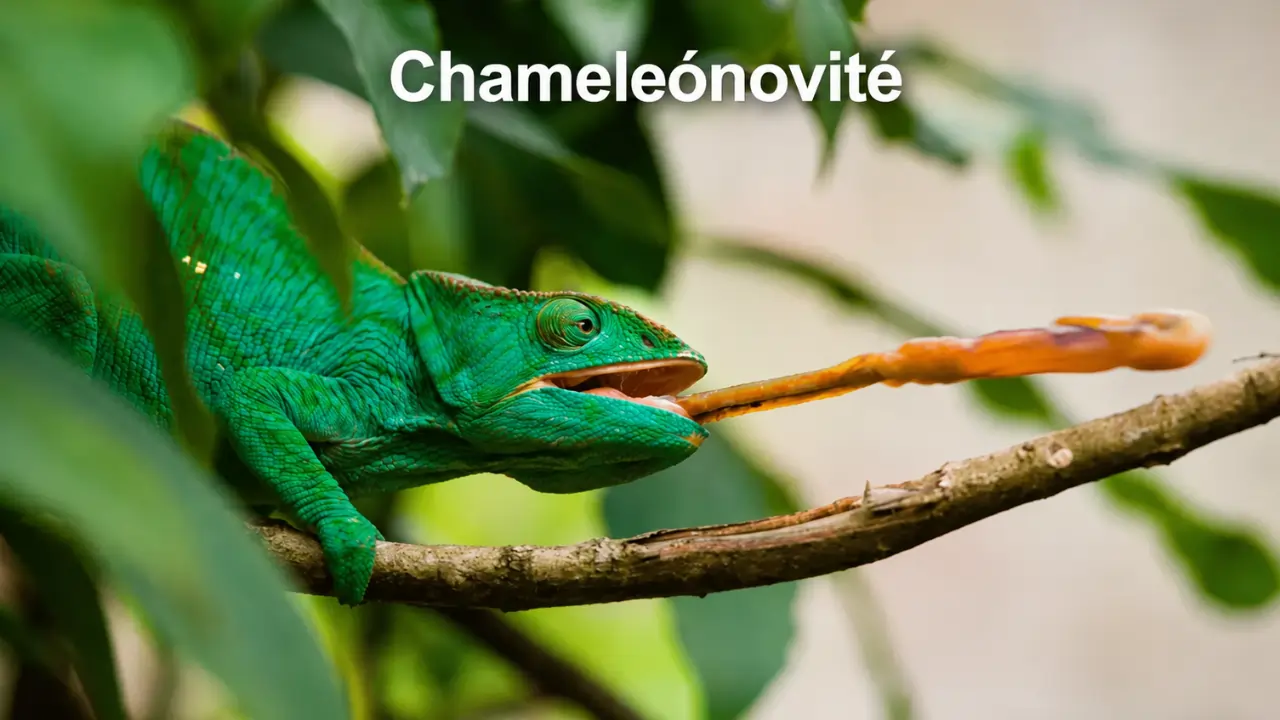
When an insect moves within range, an incredibly powerful tongue launches forward at astonishing speed. In several species, the tongue extends farther than the body itself before the sticky tip captures the target in a fraction of a second.
Crickets, grasshoppers, beetles, flies, caterpillars, moths, spiders, and other small invertebrates form the foundation of their diet.
Larger species occasionally consume small birds, young reptiles, or tiny mammals, although insects remain their preferred food source throughout life.
Remarkable Species Diversity
More than two hundred recognized species belong to chameleónovité, and each demonstrates its own combination of size, color, habitat preference, and behavior.
The Panther Chameleon is famous for its brilliant coloration and impressive regional color variations.
The Veiled Chameleon is recognized by its tall casque and adaptability.
Jackson’s Chameleon stands out because of the horn-like projections found on males.
Tiny pygmy chameleons barely exceed a few centimeters in length, while Oustalet’s Chameleon ranks among the largest members of the family.
This diversity shows how successfully chameleónovité have adapted to different environments while maintaining the core characteristics that define the family.
Survival Depends on Patience
Watching chameleónovité in the wild quickly reveals an important lesson.
They waste almost no energy.
Instead of rushing through vegetation, they pause frequently, observe carefully, and move only when necessary. Their slow, swaying walk even resembles the movement of leaves in the wind, making them less noticeable to both prey and predators.
Patience is not weakness.
For chameleónovité, it is one of the greatest survival strategies ever developed by reptiles.
Reproduction Varies Between Species
Reproduction among chameleónovité demonstrates impressive flexibility.
A large number of species lay eggs beneath loose soil, selecting locations with stable moisture and temperature conditions.
Others give birth to live young, particularly species living in cooler climates where eggs would face greater environmental challenges.
Egg incubation can last several months, with certain species requiring nearly a full year before hatching.
Young chameleons begin life without parental protection. From their first days, they must locate food, avoid predators, and navigate complex environments entirely on instinct.
Only a small percentage survive long enough to reach adulthood.
Why Healthy Forests Matter
The future of chameleónovité depends heavily on healthy ecosystems.
Deforestation removes feeding areas, nesting locations, shelter, and safe movement corridors all at once. Once forests become fragmented, isolated populations face reduced breeding opportunities and declining genetic diversity.
Illegal wildlife collection adds another challenge, particularly for rare species prized within the exotic pet trade.
Climate change also influences rainfall patterns, vegetation growth, and insect populations, all of which directly affect survival.
Protecting forests does far more than preserve beautiful reptiles. It safeguards entire ecosystems where countless plants and animals depend on one another.
Their Role in Natural Ecosystems
The importance of chameleónovité extends beyond their striking appearance.
By feeding on insects, they help maintain ecological balance and naturally regulate populations that might otherwise expand unchecked.
They also serve as prey for birds, snakes, and mammals, creating an important connection within forest food webs.
Because these reptiles respond quickly to environmental disturbance, declining populations often signal deeper ecological problems before those issues become obvious elsewhere.
Healthy populations usually indicate healthy forests.
Responsible Pet Ownership Requires Commitment
Interest in keeping chameleónovité as pets continues to grow, but success requires preparation rather than enthusiasm alone.
Proper enclosures must provide climbing branches, live plants, controlled humidity, suitable temperatures, high-quality lighting, and balanced nutrition.
Frequent handling should be avoided because excessive stress can affect long-term health.
Each species has unique care requirements, making careful research essential before bringing one home.
Responsible ownership begins with understanding that these reptiles are highly specialized animals rather than decorative pets.
Fascinating Facts That Deserve More Attention
Several facts about chameleónovité deserve greater recognition.
Their tongue can accelerate faster than the blink of a human eye.
Their independently moving eyes provide nearly complete awareness without requiring body movement.
Their gripping feet and prehensile tail create one of the most effective climbing systems found among reptiles.
Several species rank among the smallest reptiles in the world, while others exceed half a meter in total length.
Despite their famous appearance, their intelligence lies in efficiency. Every adaptation reduces wasted energy while increasing survival.
Conclusion
The lasting appeal of chameleónovité has never depended on colorful skin alone. Their real achievement is the extraordinary way every physical feature supports a highly specialized lifestyle. They climb with confidence, hunt with remarkable precision, communicate through changing colors, and survive by making every movement count. In a world that often celebrates speed, chameleónovité prove that patience, accuracy, and adaptation can be even more powerful. That combination secures their place among the most remarkable reptiles on the planet.
FAQs
1. Why do chameleónovité move so slowly?
Slow movement helps them avoid detection, conserve energy, and approach prey without creating vibrations that could reveal their position.
2. Are all chameleónovité able to change into every color?
No. Each species has its own natural color range, and changes are influenced by mood, temperature, communication, lighting, and environmental conditions.
3. Which country has the greatest diversity of chameleónovité?
Madagascar supports the highest diversity, with a large number of species found nowhere else in the world.
4. Can chameleónovité live successfully in captivity?
Yes, but only when their environmental needs, lighting, humidity, nutrition, and enclosure design closely match the conditions required by their particular species.
5. What makes chameleónovité different from most other reptiles?
Their independently moving eyes, projectile tongue, specialized climbing feet, prehensile tail, and advanced color-changing abilities create a combination of adaptations rarely found together in any other reptile family.
Read More: Cyanová: Modern Design, Branding, Creative Uses & Lasting Visual Appeal